Showing posts with label tour history. Show all posts
Friday, April 1, 2011
mount kawi history tour
Have you ever heard of or visited the site Pura Gunung Kawi during your vacation in Bali, or you totally blank no clue. in that case because of the things history is very busy lately discussed briefly I will tell the history of this object, hopefully useful add insight and reference your sights during the holidays in Bali,
After passing through the gate and 315 stairs on the riverbank Pakerisan is a river that has a very high historical value, lies Gunung Kawi temple complex.Sightseeing is included in the Tampaksiring, Gianyar regency about 40 km from Denpasar.
Regarding the name of the Gunung Kawi is not known with certainty their origins. But etymologically (term is) said to derive from the word meaning Mountain and Kawi Gunung Kawi is a mountainous area and is a sculpture, so the point is that there are carvings in the mountains or on the rock Rock.
Historically that among the kings who ruled Bali Bali, the most famous of the dynasty Warmadewa, King Udayana was derived from this dynasty and he was the son of the Queen which was adopted by Campa Warmadewa. As an adult he married the daughter of the master spoon from east Java (Kediri) named Gunapriya Dharma Patni, the marriage he is down Erland (not the store name you know ... ..) and Children Wungsu. Finally after Erland died in 1041, divided his kingdom in eastern Java 2 (two). Buddhist monk named MPU Baradah sent to Bali for Bali island is given to one son Erland, but rejected by the MPU Kuturan.
Next Bali was ruled by King Children Wungsu between the years 1049-1077 and under pemerintahanya Bali is a lush and peaceful area.
After he died his ashes kept in a temple of Gunung Kawi Temple dikomplek. Papers contained in this site entrance reads "Hajj Lumah Ing Jalu" which means the King is buried in "Jalu" equal to "spur" of (a rooster) that looks similar to Kris, the words "Ing Jalu" can be interpreted as a clue "This time Kris" or Pakerisan. The king who was buried in Jalu referred to is the King Udayana, Children Wungsu, and 4 people consort of King and Prime Minister King.
To the southeast of the temple complex is situated temple (place of residence or a dormitory of the Monk / Buddhist priest). Artefacts and Vihara Temple in Gunung Kawi is estimated on the 11th century BC and also a form of tolerance Bergama life at that time that should be an example and model for us at this time, learn from the wisdom of the past ... ....
Visiting the site Pura Gunung Kawi, the memberika you insight and captivating natural beauty. Welcome to visit Bali
kuta beach bali history
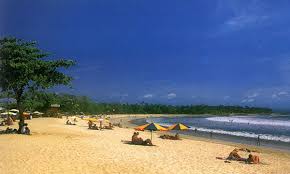
Already since the 1960s until today, Kuta is known as the busiest tourist spots in Bali. Tourists come to have fun in a small village in Badung this. Kuta increasingly identically as a place with sparkling image: surfing, shopping, Sun Bathing, or just to enjoy a world atmosphere in recent nights.
Ironically, in addition to the beach and the world at night, Kuta itself is not too have a place as a tourist visit.Unlike, say, Denpasar, which have some historic locations like the Museum of Bajra Sandhi Renon Square Margarana or beside Puputan Bali Museum Badung Denpasar. Or art museums in Ubud.
"As the people of Kuta, I myself often feel uncomfortable because we lack knowledge about our own place," said Made Supatra Karang, one community leader in Kuta.
While Kuta actually have an important role in the history of modern Bali, especially in terms of tourism. Kuta can be called at the forefront of creating the image of Bali as a location for world tourism. Because of that Kuta has the potential to be a historical sights. Especially since the old Kuta is also known as the place that gives a place for pluralism.
To know Kuta as a historic place, Supatra introduce five places that have a role in the history of Kuta. Five places were Pasih Beach Boat, Dharmanaya Monastery, GraveyardMads Lange, Poppies Restaurant, and the Bali Bombing Monument. Two last names are widely known. Therefore, we will visit three places namely lai Pasih Coast Boat, Vihara Dharmayana, and the Tomb of Mads Lange.
According to the official history book of the Government of Kuta Village, Kuta began to be known when in 1336 AD, Gajah Mada from the Majapahit and his troops landed on the southern coast. This area became known as Tuban, like one of a small town on the coast of East Java.
Because a good place for landing ship, this area slowly became a small port. Residents also mentioned areas in Banjar Segara Kuta is the name which means the beach Pasih Boat boat. According to Nyoman Rica, Head of Environment Banjar Segara Kuta Kuta history can not escape from the existence of this boat pasih. "Therefore everyone who wants to know the history of Kuta indeed have to start from here," said Rika some time ago.
Currently, there is no historical evidence whatever that this beach never had an important role in the development of Kuta .Former port here already eaten the waves, affected by abrasion. "It's deep in there," said Rika said, pointing out to sea.
Physical evidence that the place was ever so ports can be seen from the building at Temple Guesthouse in this place. At the front of the temple, there are miniature boat built in 2002. According to Rika, a boat of this cement is a form of respect for local residents on their ancestors who landed in that place.
The size of this miniature boat about 6 x 2 meter square. In the midst of these boats there are water sources which, uniquely, is a fresh water despite being on the beach. Unfortunately this place does not have much information to become a tourist attraction. However, if packed well, this place is quite interesting to be a historical tourist sites, especially about Kuta .
Another part of Kuta which could be a place to get to know the history of the monastery Dharmayana Kuta. Established around 1876 AD, the monastery Dharmayana be one of the oldest buildings in Kuta. He became a silent witness of the era history of Kuta Bali is still shaped the kingdom today.However, despite 132 years old, this temple was still very awake. Buildings are still arranged and used so far.
This monastery located on the corner between the streets and roads Padri Blambangan Kuta, Banjar Temacun entrance region, Kuta. With the color of a typical Chinese red, this temple clearly visible on the right side of the road. Ornaments such as lanterns are hung, Mandarin characters on the wall, or a dragon statue in the pole monastery became an icon typical of traditional Chinese buildings.
Dharmayana Vihara is a place of residents of Chinese descent perform daily prayers. Nevertheless, the monastery is open for anyone who wants to visit, not just those who want to worship. Therefore, tourists can visit this temple. However, in fact, not many tourists visiting the monastery who had visited the Dalai Lama in 1982.
Hindra Suarlim, Chairman of the Yayasan Dharma Semadhi that shaded monastery, said, Dharmayana built to honor His Majesty Kongco Cin Tan Hu Jin, ancestor of the Chinese citizens in Kuta .According to the owner's Chinese name is Lim Ing Hin, Cin Jin Tan Hu is an architect who designed the Taman Ayun in Mengwi, Badung. Jin Taman Ayun was built in in 1716 AD
Although established as a form of homage to the ancestors of Chinese citizens, but the monastery is still allowed to visit anyone, including tourists. Usually the tourists who come are from China , Japan, or Korea. Tourists from Europe and America are very rare. "If they want to worship here is fine," said Luwih Beratha, chairman of the monastery.
Visiting the monastery Dharmayana Kuta, we will simultaneously learn about the history of Chinese citizens in Kuta , Bali island in general. Since the beginning of his arrival in Bali in the 18th century, Chinese citizens choose to trade jobs. This profession also influenced the development of Kuta to the present. Chinese citizens continue to be one group that determines the economic wheels of Kuta, especially in terms of trade.
In various books on Kuta stated that the Dutch colonial era, Kuta be one trading center in Bali.At that time, a Danish citizen named Mads Johansen Lange became Syahbandar Kuta. I Made A piece Sujaya in his book Conscience of Kuta (LPM Kuta, 2004) mentions that in the hands of Mr. Lange, as people used to call Kuta, Kuta is increasingly developing into a very advanced and famous. Therefore, talking about Kuta is also inseparable from the position of Mr. Lange if a little smelly colonial.
Mads Lange Tomb located in the eastern part of Kuta, next to Tukad Dead, is about 100 meters from the road By Pass Ngurah Rai Kuta. There is a street named Mr. Lange is like showing how important the Lange position so that his name immortalized as the name of the street. Again, unfortunately, this place did not have enough information as a tourist attraction. While this location could have been packaged as a historical tour, for example with a clearer description of who Mads Lange and how his role in the development of Kuta.
Currently, not much to look at the tombMads Lange . There are only about 3 feet tall monument with the inscription Sacred to the Memory of Mads Johansen Lange. This monument is somewhat separate from other graves in the Chinese cemetery. Historically, Mads Lange was married to the woman of Chinese descent. Because of that he was buried in the cemetery this Chinese. Without a guardian and a written statement about the place, the tomb of Mads Lange could not tell a lot about the history of Kuta .
Three sites, along with Poppies Restaurant-one of the oldest restaurants in Kuta and Bali bomb monument, to commemorate the tragedy of the bombings in Kuta on October 12, 2002 actually could be an attractive tour packages. Each other is no more than 30 minutes if taken with a motorcycle or car. It did not take a day to explore everything.
Unfortunately not a single travel agent or tour players who make these places as a tourist activity history. If ever there was one tourists who come, usually only because of personal interest, not offered by travel agents.
However, according to Supatra Karang, the majority of residents in Kuta today is start thinking about the need for any historical attractions in Kuta. "We were thinking that way lately. Kuta should have a museum of history or package tours to historic places, "said Chairman of the Kuta Small Business Association is. But this is still limited to ideas, no action whatsoever.
This, he added, because of the lack of sources that can tell each venue. "Still, perhaps it should have started it. If no one start, so just going to be an idea, "added the initiator of the annual activities of the Kuta Karnival this.
Monday, March 21, 2011
park Ayun Temple

Taman Ayun temple in Badung, Bali, was built in 1634 AD by the first king of the Kingdom of Mengwi, I Gusti Agung Ngurah Made Agung who holds Ida Cokorda Sakti Belambangan. Mengwi Kingdom is one of the powerful kingdom in Bali, which lasted until 1891. This temple was built as a place to worship the king and his family.Unlike the other pretended in Bali that 'oriented' on Mount Agung, Pura Taman Ayun 'oriented' to Mount Batukau.
Taman Ayun in Bali means 'beautiful garden'. The complex of religious buildings are located within an area of 4 hectares with a pond or a ditch surrounded. From a distance, it resembles trench 'bracelet water' and give the impression that this temple is above the water surface. All around the temple, there is a grove of trees and flowers that add a lovely atmosphere.
Taman Ayun Temple complex consists of three parts. The first part is an open space used for various religious activities and stage arts. In the first part of this visitors can enjoy the beautiful arrangement of Meru, the pagoda with a typical terraced roof temple building in Bali. The second part is the main building, a building named Bale complicated. Bale Building was decorated by delicate sculpture, reliefs, and sculpture Dewa Nawa Sanga who is captivating. While other parts of the buildings are reserved for gods and goddess of the sacred in Hinduism.Every day, the temple which was renovated in 1937 is visited by around 300-600 tourists both from within and outside the country.
B. Feature
Pura Taman Ayun has been proposed by the government of Indonesia as one of the world cultural heritage sites (World Heritage). On 12 March 2008, UNESCO Director General Matsuura visited Kokhiro Pura Taman Ayun to assess its feasibility. This temple is considered to have historical value, cultural, religious, and have high artistic taste.
Although a part of cultural heritage, but Pura Taman Ayun is still used as a place of worship until now. Visiting this temple, tourists can enjoy the beautiful temple building which has been almost 400 years old. In addition, natural panorama around the temple, such as trees, flowers, and grass well maintained, thereby increasing the impression of cool neighborhood temple.
Visitors can also see relics of the kingdom Mengwi located about 300 yards from this temple. Across the temple there are also Manusa Yadnya Museum, which is a museum that showcased the ceremonies associated with the human life cycle starting from when he was in the womb until death.
C. Location
Mengwi Village, District Mengwi, Badung regency, Bali province.
D. Access
Village distance from Denpasar town Mengwi approximately 18 km to the northwest. To go Mengwi Village, tourists can follow the route of public transport (bus / bemo) majors or Denpasar Denpasar-Singaraja, Bedugul with travel time about 25 minutes. Tourists can go down at the crossroads in the village of Mengwi to then walk to the temple complex which is about 250 meters. Tourists can visit the temple between the hours of 8:00 to 6:00 p.m. PST
Wednesday, March 16, 2011
Mendut is a temple located at
Mendut is a temple located at the east of the straight line set of three temples (Borobudur, Pawon , Mendut). This temple was founded by the dynasty dynasty and set berlakang Buddhism, where it is shown by the shape of the stupa there are 48 pieces in the atasnya.Tidak known exactly when this temple was founded. But a Dutch archaeological mention that in the inscriptions found in villages Karangtengah bertarikh 824M stated that the king Indra has built a shrine called venunava which means bamboo forests. If this is true then surely Mendut founded in the 8th century AD.
On the inside of this temple there is a room that contains the altar where the three statues of Buddha stands. The three statues are starting from the far left is Vajravani Bodhisattva, the Buddha Sakyamuni and Bodhisattva Avalokitesvara. The three statues of Buddha are still in good condition, some flowers and incense appears to lay underneath.An iron fence was built at the front of the statue is to avoid excessive visitor interaction / was not concerned over this third Buddha statue.
Reliefs found on the temple walls is still clearly visible form / carvings. Relief contains a story of moral teachings using animal figures (fable) as cast. There is a story of "Brahmin and the Crab", "Goose and the Tortoise," "Two Birds Betet Different" and "Dharmabuddhi and Dustabuddhi", which was briefly the contents of the story is as follows:
Brahmins and Kepeting ": Tells the story of a Brahmin who rescued a crab for crab is then return the favor with a way to save Brahmins of crows and snakes disorders.
"Goose and Turtle": A story about a tortoise who was flown two geese kedanau new. Because the emotion in the reply to the words for what they do, the turtle let go so that falling ground and eventually die.
"Two Birds Betet a Different": Tells parrot behavior of two very different because it only brought up by the Brahmins and the other by a highwayman.
"Dharmabuddhi and Dustabuddhi":Two different friends who have a behavior where Dustabuddhi disgraceful nature Dharmabuddhi accused committed a disgraceful act, but eventually his crime was uncovered and Dustabudhi-sentenced.
Chronologically, Mendut discovered in 1836. Later in the renovation in 1897 and 1904 on the body is but the results are less satisfactory. Redeveloped in 1908 by Dutch archaeologists until the peak can be rearranged. In 1925 a number of stupas that have been dirapihkan, mounted and rearranged. Building area as a whole is 13.7 x13, 7 meterdengan 26.4 meters high.
source: tourthebali.tk
Monday, March 14, 2011
Temple history Singosari
If we always identify with the temples of Central Java, then this assumption is no longer true, because Malang also have them. A temple built to commemorate the death of King Singosari , King Kertanegara, has become one of the resorts in Malang. This temple is a temple Singosari , or temple "Singhasari", which is building a place of worship the king or the king's ancestors.
Located in a cool valley, in a quiet village, among the Tengger Mountains and Mount Arjuna, Singosari temple can be reached about 40 minutes from the city of Malang, precisely in the village Candirenggo, Singosari Sub Malang (about 10 km north of the city of Malang .)
A historical view has been greeted us before getting to this temple.Because not far from this temple we will find two large statues of nearly 3.70 m tall is named Dwarapala, still standing in place of the original, the custodians of the road leading to the enshrinement.
Photo by Regional News / Hannah
The roof of the temple only partially live, but has finished with a garnish of finely carved, while the bottom is plain. Temple Singosari not stand alone but all around the yard of the temple are still found in many statues.Bibs by Regional News / Hannah
In the field found a framed inscription of 1351 AD From the writings in this inscription historians concluded that the temple Singosari Kertanegara closely associated with the king of the Kingdom Singosari . The building was probably established in conjunction with sraddha ceremony, a ceremony to commemorate 12 years after King's death in 1304 AD,in the reign of Raden Wijaya, the king of Majapahit I.Other notes from Kakawin Nagarakertagama Prapanca essay, stanza XLII-XLIII, mentions that the King Kertanegara is a king who was very respected. Written that he had mastered all kinds of knowledge such as Sadguna (the science of state administration), Tatwopadeso (the science of nature), law-abiding, steadfast in carrying out the provisions relating to religious worship of Jina (apageh ing jinabrata), persevere in running prayogakrya ( tantric rites.) Kertanegara is the last king of the Kingdom of Singosari who ruled in 1268-1292 AD He was killed in a revolt led by Jayakatwang , king bawahaannya. Singosari temple was built to commemorate his death.
Photo by Regional News / Hannah
If we want a different tour, visit the temple Singosari. Enjoying a relic of history will give special experience for us. Surely adding the pride we become a nation of Indonesia with its cultural heritage is so rich ..source: tourthebali.tk
Subscribe to:
Posts (Atom)